
Victoria, B.C. Lək̓ʷəŋən territory: As British Columbia heads into another difficult drought season, new research from the POLIS Water Sustainability Project at the University of Victoria’s Centre for Global Studies offers recommendations to create a drought-ready B.C.
Released today, Drought Ready analyzes the last decade of droughts and drought management in B.C. and offers practical guidance to move away from reactive crisis response and toward proactive drought planning.
“We need to fundamentally shift how we understand and manage for drought in B.C.’s new climate reality,” said Rosie Simms, director of place-based initiatives at POLIS and report co-author. “B.C.’s water management systems are based on the idea of water abundance, but this is no longer the case. Droughts are becoming more frequent, severe, and damaging year-round issues — and provincial water management urgently needs to catch up.”
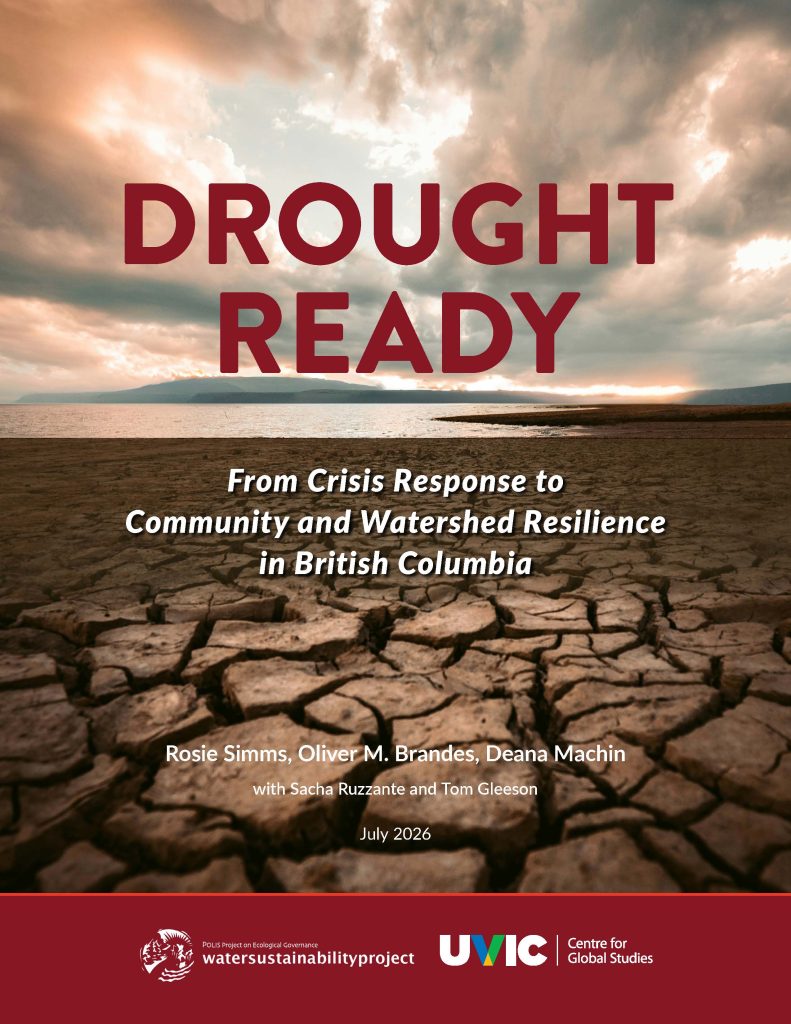
In the last 10 years, B.C. has, more than once, experienced the worst drought in its recorded history.
The authors focus on the provincial government’s foundational role in responding to water scarcity, avoiding crisis, and building resilience from the community level up. Despite its key role, no large-scale government initiative has yet been mobilized to address the growing impacts of drought in B.C.
“British Columbians need watershed security, and the provincial and federal governments have committed to collaborating on water and watershed protection as the foundation of B.C.’s economy, energy systems, health and well-being, wildlife, and climate resilience,” said Oliver M. Brandes, co-director of POLIS and report co-author. “The province has a crucial role, and our report lays out the minimum of what that leadership should look like, including investing the necessary resources and committing to a proactive, drought-ready response as an urgent priority.”
The government already has significant legal, policy, and planning tools to make this happen, say the authors, but implementation has been slow or lacking, leaving B.C. communities vulnerable and scrambling when drought hits.
Drawing on best practices and innovative examples from around the world, the authors reimagine B.C.’s drought future and identify five areas where government must focus its attention to successfully reform drought management in B.C.:
- Deploy and use existing water legislation and regulations to their fullest potential.
- Redefine our understanding of drought in B.C.
- Promote water conservation and efficiency.
- Expedite water and watershed sustainability planning.
- Resource and empower local drought governance and response.
“Addressing each of these five areas will be essential to better safeguard communities and ecosystems,” said Deana Machin, strategic advisor at POLIS, senior Indigenous advisor at the Indigenous Watersheds Initiative, and report co-author. “Across the province, First Nation and non-First Nation communities are stepping up to address drought in innovative ways, but we need provincial government leadership and a foundation that will allow these local responses to have their fullest impact and reduce drought risk.”
While droughts cannot be prevented, their impacts can be meaningfully reduced through a comprehensive suite of actions, say the authors. The report offers a pathway forward and provides clear guidance on not only how to live with drought, but how to thrive in a climate-changed world.
-30-
Download:
Full Report>
Media contacts:
Laura Brandes (POLIS Water Sustainability Project) at [email protected]
Simone Blais (University Communications and Marketing) at [email protected]
The following experts are available to media for comment about droughts in B.C.:
Rosie Simms (POLIS) is an expert in B.C. provincial water policy and local governance. She can discuss how drought is changing in B.C., how B.C.’s water and drought management systems are currently functioning, and recommendations to improve provincial drought management.
Oliver Brandes (POLIS) is an expert in water sustainability, watershed security, resource management, wildfire resilience, public policy development and ecologically based legal and institutional reform. He can discuss how effective drought management will ensure watershed security in B.C. and solutions for future decision-making.
Deana Machin (POLIS) is an expert in fisheries management and water and First Nations governance. She can discuss how drought is affecting communities in B.C. (including specific impacts on First Nations), how communities are responding, and the need for provincial government support, resources and action in regional drought planning and response.
Sacha Ruzzante (PhD candidate, UVic Engineering) is an expert in historical streamflow declines, climate projections and glacier loss. He can discuss future modelling of drought in B.C.
Tom Gleeson (UVic Engineering) is an expert in the role of groundwater in drought and water management. He can discuss the importance of groundwater in future drought planning for B.C. He is available after July 20.


